
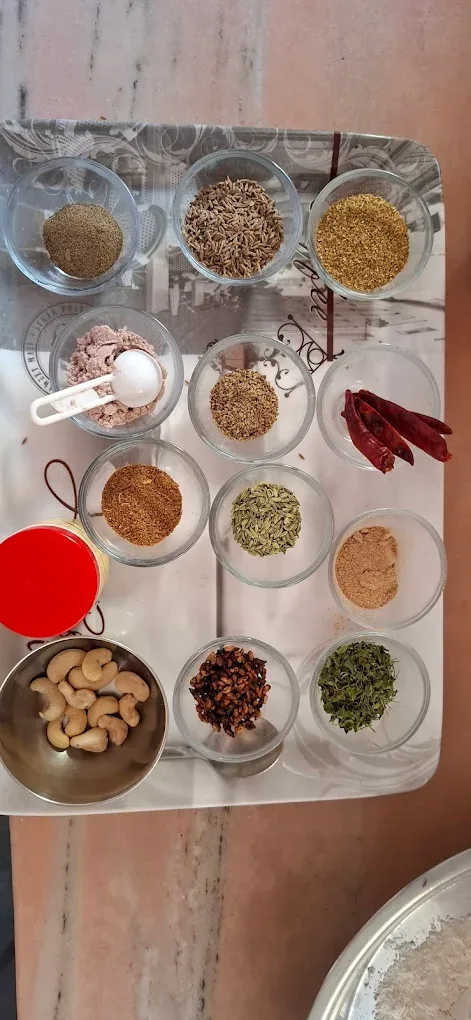
Rishikesh has a particular relationship with Ayurveda. You cannot walk five minutes here without passing an Ayurveda clinic, an herbal medicine shop, or a retreat advertising “Ayurvedic detox.” Some of it is tourism. Some of it is genuinely how people have cooked and lived here for a long time.
I think about Ayurveda mostly through digestion. Not in the clinical sense, I am not a practitioner, but in the practical kitchen sense: certain spices help settle your stomach, others stimulate appetite, some cool you down, some warm you up. My grandmother-in-law cooked this way without ever using the word Ayurveda. She just knew that you add asafoetida to lentils because it helps with gas, or that raw garlic on an empty stomach is asking for trouble.
Here are five spices that come up in almost every class I teach, and how I actually think about them.
Turmeric (haldi)
The most talked-about one. Fresh turmeric root looks like a small, knobby ginger rhizome, bright orange inside. Dried and powdered, it becomes the yellow everyone associates with curry.
What I notice in cooking is simpler than the science: turmeric adds depth without adding much flavor. It is background. You can taste when it is missing more than when it is present. Use too much and the dish turns bitter and slightly chalky.
A quarter teaspoon per serving is usually enough. Almost every Indian cook uses less turmeric than visitors expect.
Turmeric in warm milk, haldi doodh, what the West has started calling golden milk, has been a home remedy in North Indian households for generations. My mother made it for me when I was sick as a child. I still make it. It works well enough that I keep making it.
Cumin (jeera)
Cumin is carminative. It helps relieve gas and bloating. This is probably why it shows up in dal, in salted lassi (the digestive one, not the sweet mango version), and in jeera water that some people drink in the morning.
Whole cumin seeds bloom in hot oil in about 30 seconds. They go from smelling faintly dusty to aromatic and toasty very quickly. If you drop seeds into oil and nothing happens, the oil is not hot enough. Wait.
Ground cumin has a different, flatter character than whole seeds. Both are useful. They do not substitute for each other easily in most recipes.
Ginger (adrak)
Fresh ginger is warming. Dried ginger (sonth) is even more so. Ayurvedic cooking actually distinguishes between them. Fresh ginger is considered better for nausea and acute digestion issues; dried ginger for chronic digestive support and circulation. I cannot verify the pharmacology, but the difference in taste is real.
In everyday cooking, I use fresh ginger almost every day. Ginger-garlic paste, equal amounts blended together, is the base of most North Indian gravies. You can make a week’s worth and keep it in the fridge.
For a sore throat or upset stomach: slice fresh ginger, simmer in water for 10 minutes, add honey after taking it off the heat (honey loses its properties when boiled). That is it. I do not always have lemons. I always have ginger.
Black pepper (kali mirch)
Before chili reached India from the Americas in the 16th century, black pepper was the main source of heat in Indian cooking. It is still used more in South India than in the North, where chili has largely taken over.
Piperine, the compound that makes pepper hot, increases how much curcumin your body absorbs from turmeric. Traditional Ayurvedic medicine combined them for this reason, long before researchers figured out the mechanism. The combination appears in hundreds of classical recipes.
Freshly ground pepper is noticeably more pungent than pre-ground. If you have a pepper grinder and you are not using it, you are missing something.
Cardamom (elaichi)
Green cardamom is considered cooling in Ayurvedic terms. It appears in sweet dishes, in masala chai, in biryani, and as a mouth freshener offered after meals. The pods are sometimes kept in a small bowl near the door so guests can take one on the way out.
There are two types: green (floral, slightly sweet, the common one) and black (smokier, used in savory rice dishes and some gravies). They are not interchangeable. Using black cardamom in kheer will ruin the dessert.
To use green cardamom: crack the pod with the flat side of a knife, remove the seeds, crush them. The pod itself goes into tea and biryani for flavor, but you do not eat it whole. The texture is unpleasant.
These five spices show up in Indian cooking so often that learning them is not really optional if you want to understand what you are eating. They are not exotic additions to a recipe. They are the foundation of the kitchen.
If you are in Rishikesh and want to cook with these spices hands-on, come spend a morning in my kitchen. We will talk through each one before we start cooking.