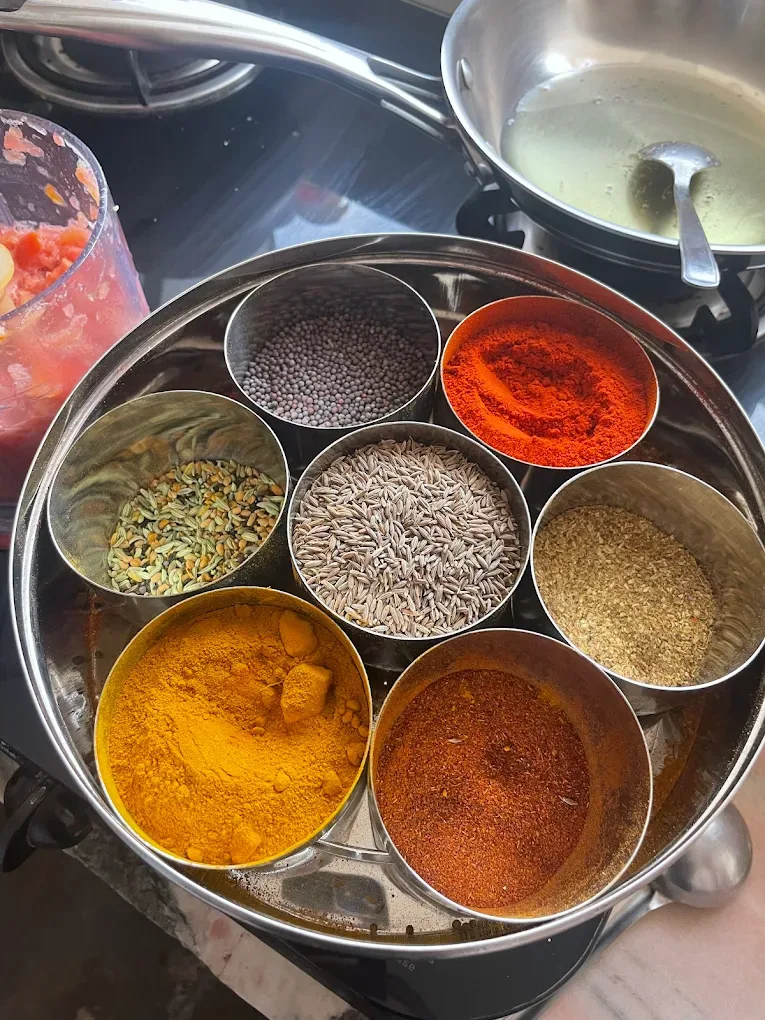
Every Indian kitchen has a masala dabba. Mine sits on the counter to my left while I cook, within arm’s reach at all times. It is a round steel box, usually the size of a dinner plate, with a tight lid and seven small steel cups inside. Each cup holds one spice.
When travelers come to my class in Rishikesh, the masala dabba is usually the first thing they want to photograph. I understand. It looks beautiful, the different colors packed into the little cups, the smell that hits you when you open the lid. But I always say: put the phone down and smell first. Smell each one separately. That is how you begin to understand them.
What is typically inside
Every family’s dabba is different. In North India, you will almost always find these seven:
Turmeric (haldi) gives dishes their yellow color. It is mildly bitter and earthy. Most cooks use very little, around a quarter teaspoon per dish. It stains everything: your fingers, your cutting board, your clothes. Do not wear white when you cook with fresh turmeric root.
Cumin (jeera) comes in two forms: whole seeds and ground powder. They are not interchangeable. Whole seeds go into hot oil first and bloom within 30 seconds. You will hear them sizzle and smell them change. Ground cumin gets added later with the other powder spices. Missing this sequence is one of the most common mistakes beginners make.
Coriander powder (dhaniya) is the workhorse of Indian cooking. It has a slightly citrusy, nutty quality and forms the base of most gravies. You will use more of it than any other powder spice in the dabba.
Red chili powder (lal mirch): this is where it gets interesting. Kashmiri red chili gives color more than heat. Regular red chili powder gives both. Most home cooks combine them: Kashmiri for the deep red color, a pinch of regular chili for the kick. When guests ask me to make something “not too spicy,” I use only Kashmiri.
Garam masala is a pre-mixed blend: cardamom, cinnamon, cloves, black pepper, and bay leaf are typical, though every family has a different ratio. It goes in at the end of cooking, not the beginning. My grandmother-in-law used to make her own blend by hand every few weeks. I do the same. Pre-packaged works, but fresh is noticeably better.
Salt lives in the dabba. Close enough to grab without looking.
The seventh cup varies by cook and region. In my dabba it holds mustard seeds for tempering. In some kitchens you will find asafoetida (hing), fennel seeds, or ajwain. There is no universal answer. Ask the cook.
How to actually use it
Most North Indian cooking follows the same sequence. Hot oil first. Whole spices next. They need time to release their flavor. Onion if the recipe calls for it. Then garlic and ginger. Then powder spices, always with liquid nearby because they burn in ten seconds flat. Salt early if you are cooking vegetables; later if you are building a gravy.
Once you understand that sequence, the dabba makes sense. You are not choosing randomly from seven cups. You are working through a process.
A lot of my students try to memorize recipes before learning the base. I usually stop them. Learn the base first. Once you know it, you can cook without a recipe in front of you.
Building your own masala dabba
If you are starting from scratch, buy four things first: whole cumin seeds, coriander powder, turmeric, and a red chili powder. Those four will carry you through most North Indian home cooking. Add garam masala once you feel comfortable. Buy it from a shop that makes their own if you can find one.
Do not fill all seven cups at once. Fill them as you need them. That way you will know what you actually use and what is just sitting there going stale.
My dabba has a small dent in the lid from the day my daughter knocked it off the counter years ago. I could replace it but I have not. It seals fine and it feels like mine.
Come join one of my cooking classes in Rishikesh and I will walk you through each spice in person. Smell, taste, and all.